Collateral-Pledged Crypto Loans Explained for Miners
A collateral-pledged crypto loan lets a miner turn held coins into spendable liquidity without selling them, in five steps: add collateral, apply for the loan, receive the disbursement, repay, and redeem the collateral. The useful way to size one is runtime, not headline amount — at the read-date network hashrate a 1.5 PH/s fleet produces 0.005 BTC in about 7.4 days, while a 15 TH/s rig would need roughly 743 days for the same figure.
Key takeaways
- The process is five steps — collateral, application, disbursement, repayment, redemption — and the collateral is what stands between a temporary cash gap and a forced sale.
- Size the loan against mining runtime. A 0.005 BTC obligation takes about 7.4 days of output at 1.5 PH/s, about 74 days at 150 TH/s, and roughly 743 days at 15 TH/s.
- A 10 PH/s fleet of 20 J/TH machines pays about $288 a day of electricity at $0.06 per kWh against roughly $379.93 of gross income — the gap a loan bridges is real, and so is the repayment obligation.
- A loan does not change expected mining income and cannot guarantee a better outcome. It changes when you hold coins, and adds a repayment schedule that exists regardless of what difficulty does next.
The short answer
Mining produces coins on the network's schedule while electricity arrives on the utility's schedule, and the two rarely line up. A collateral-pledged loan resolves that mismatch by borrowing against crypto you already hold instead of selling it at an inconvenient moment. The collateral stays in the account, the loan releases liquidity, and the position is closed when you repay and redeem.[1]
The trade is straightforward and should be stated plainly: you gain liquidity and keep your position; you take on a repayment obligation and the risk attached to the collateral's value. Nothing about the loan changes how many coins the network issues — which is the point worth holding on to when a ViaBTC Crypto Loan is being sized against a working fleet.
How the mechanism works
The published flow has five stages, and each one has a specific thing worth checking before you move to the next.
| Stage | What happens | What to verify before continuing |
|---|---|---|
| 1. Add collateral | Crypto is pledged against the loan | Which asset you pledge, and what the position depends on |
| 2. Apply | Loan terms are set on the pledged position | The repayment schedule and how it maps onto your mining income |
| 3. Disbursement | Funds become available | Where the funds land, and whether an extra transfer step can be avoided |
| 4. Repayment | The obligation is paid down | That repayments come from income, not from selling the collateral they secure |
| 5. Redemption | The collateral is released | That the release is confirmed in the account before you plan the next move |
The stage that decides whether the whole structure helps or hurts is the fourth. A repayment funded from current mining income is a cash-flow tool. A repayment funded by the collateral itself is a slow liquidation with extra steps, and it converts a liquidity decision into a position decision.
Where miners get it wrong
The first mistake is sizing the loan in fiat terms while the obligation is denominated in crypto. Convert the obligation into days of mining output at the read-date network hashrate, then compare that with the period you are actually bridging. A 0.005 BTC obligation is about 7.4 days at 1.5 PH/s but roughly 743 days at 15 TH/s — the same number, two completely different situations.
The second mistake is treating the loan and the mining pool as a single cost. They are separate: the pool's listed fees are 4% on the PPS-settled block-reward component and 2% on the PPLNS-distributed components, applied to income you earn, while the loan is a repayment obligation on money you have already received. Both belong in the same cash-flow model, and neither offsets the other.
The third mistake is assuming the mining side will cover everything on the original schedule. Difficulty moves — the estimate on the read date was −2.12%, helpful, but the direction can reverse — and a fleet that throttles in a hot month produces fewer coins than the plan assumed. A structure that only works if everything goes right is not a cash-flow tool.
Numbers from a mining operation
Take a 10 PH/s fleet built on 20 J/TH machines. Its power draw is 200 kW, or 4,800 kWh a day, which costs about $288 a day at $0.06 per kWh. Gross mining income at the read-date difficulty, network hashrate and $84,692 BTC price is about $379.93 a day, and after the listed 4% fee on the block-reward component roughly $364.73. The operating spread before hosting and capital costs is therefore in the region of $76 a day.
That spread is what makes a collateral position workable: the fleet generates coins daily, and settlement cadence decides how quickly those coins become available to service a schedule. At 1 PH/s, hourly settlement produces about 0.0000187 BTC — roughly $1.58 — every hour. That kind of cadence is what lets a repayment plan be built on production rather than on reserve.
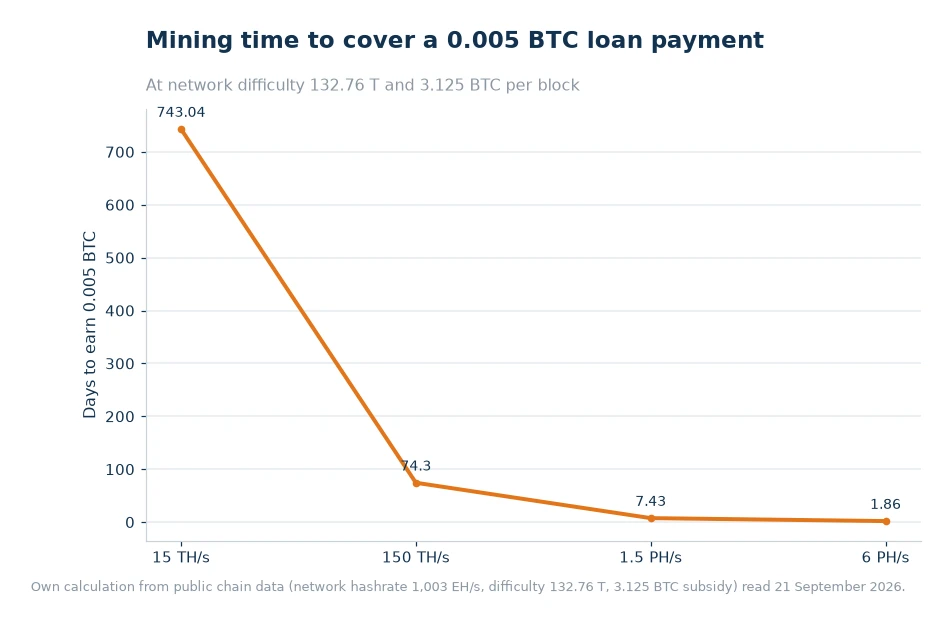
The chart converts an obligation into a date, which is the only form in which a loan size is actually comparable across operations. A 6 PH/s fleet covers 0.005 BTC in about 1.9 days; 150 TH/s needs about 74 days. Same instrument, same terms — completely different risk profile, and the difference is fleet size, not loan structure.
A checklist you can run today
- State the liquidity gap in days, not dollars. Divide the amount you need by your expected daily income at current difficulty.
- Model the repayment from production. Use hourly or per-block settlement figures, not a hoped-for average.
- Stress the difficulty line. Re-run the schedule with per-share income 5% lower; if the plan breaks, the loan is too large for the fleet.
- Confirm where both rails land. Mining payouts and loan disbursements should reach the same account so that repayment does not depend on manual transfers between platforms — an integrated multi-currency wallet next to the mining dashboard is the simplest version of that.
- Keep the fee schedule visible. A listed 4% on one component and 2% on another is not a blended number, and a repayment plan built on a wrong fee assumption is wrong every month.
- Plan the redemption before you need it. The structure only returns the collateral to its original state when the fifth step completes, and that step takes time.
If the gap you are bridging is a permanent one rather than a timing one, the honest answer is that a loan is the wrong instrument. Using a mining pool that settles hourly, keeps zero-fee mining payouts and holds balances in an account you control addresses the timing problem directly, which is what most miners actually have.
Frequently asked questions
What happens if my miner goes offline?
Shares stop, so expected income stops with them. Alerts and a dashboard that shows per-worker hashrate shorten the gap between a failure and a fix.
Is a bigger pool always better?
Size reduces payout variance but also concentrates hashrate. What matters more is fee structure, uptime, latency and payout cadence.
What is a collateral-pledged crypto loan?
A loan secured by crypto you already hold, released in five stages: add collateral, apply for the loan, receive the disbursement, repay, and redeem the collateral once the obligation is cleared.
Can a crypto loan guarantee a better mining outcome?
No. A loan adds a repayment obligation and does not change expected mining income, which depends on your share of network hashrate and current difficulty. It changes when you hold coins, not how many the network issues.
The short version
Treat a collateral-pledged loan as a scheduling instrument. Convert the obligation into days of mining output, model the repayment from current production rather than from reserves, and stress-test it against a lower per-share income. Keep the pool's fee components and the loan's repayment schedule in separate columns of the same model. Do that, and the structure does exactly what it is built for: it moves a payment without forcing a sale.
Data and sources: ViaBTC collateral-pledged loan documentation[1] and the ViaBTC fee schedule[2]. Network hashrate, difficulty, subsidy and BTC price read from public chain data on 21 September 2026. Figures are illustrative, exclude loan terms and are not investment advice.